
Tongue Tie Release for every age.
- \CO2 laser — no sutures, minimal bleeding
- \10–20 minutes · no hospital stay
- \Safe for infants as young as 2 days old
- \Hundreds of releases performed

Hundreds
releases performed by Dr. Haller
2 days
youngest patient treated safely
10–20
minutes — typical procedure time
Lactation consultant coordination
We recommend working with a lactation consultant before and after the procedure. Ask us for guidance on finding one in your area.
Types of Tongue & Lip Ties
Anterior tongue tie
Visible restriction at the tip of the tongue. The frenulum is often visible or the tongue heart-shapes when lifted. More commonly identified.
Posterior tongue tie
Restriction deeper under the tongue — often missed on visual exam. Requires palpation to detect. Frequently the cause of unexplained breastfeeding difficulties.
Upper lip tie
Tight frenulum connecting the upper lip to the gum. Often accompanies tongue tie. Affects latch, dental spacing, and upper lip mobility.
The reverse swallow — commonly misdiagnosed
A reverse swallow — where the tongue pushes forward and out of the mouth with every swallow — is a classic symptom of tongue tie in infants. Many pediatricians mistakenly interpret this as evidence that there is no tongue tie, because the tongue appears to be moving freely. In fact, the opposite is true: the tongue is compensating for its restricted range by thrusting forward. If your pediatrician has ruled out tongue tie based on tongue movement, a second opinion from a trained provider is warranted.
Tongue tie in infants — what to look for
Signs and symptoms
On examination
- Retruded chin
- Nursing blisters
- High, narrow palate
- Upper lip tie
- Finger suck that is really biting
- Mouth breathing with tongue thrust
Feeding & behavior
- Difficulty latching or maintaining latch
- Reverse swallow — tongue thrusting forward (see warning above)
- Clicking or smacking sounds while nursing
- Excessive fussiness, colic, reflux from swallowed air
- Poor weight gain despite frequent feeding
- Falling asleep at breast from exhaustion
- Milk dribbling from corners of mouth
- Biting or chewing the breast rather than sucking
- Reluctance to sleep on back — prefers side or stomach
- Snoring or restless, unsettled sleep
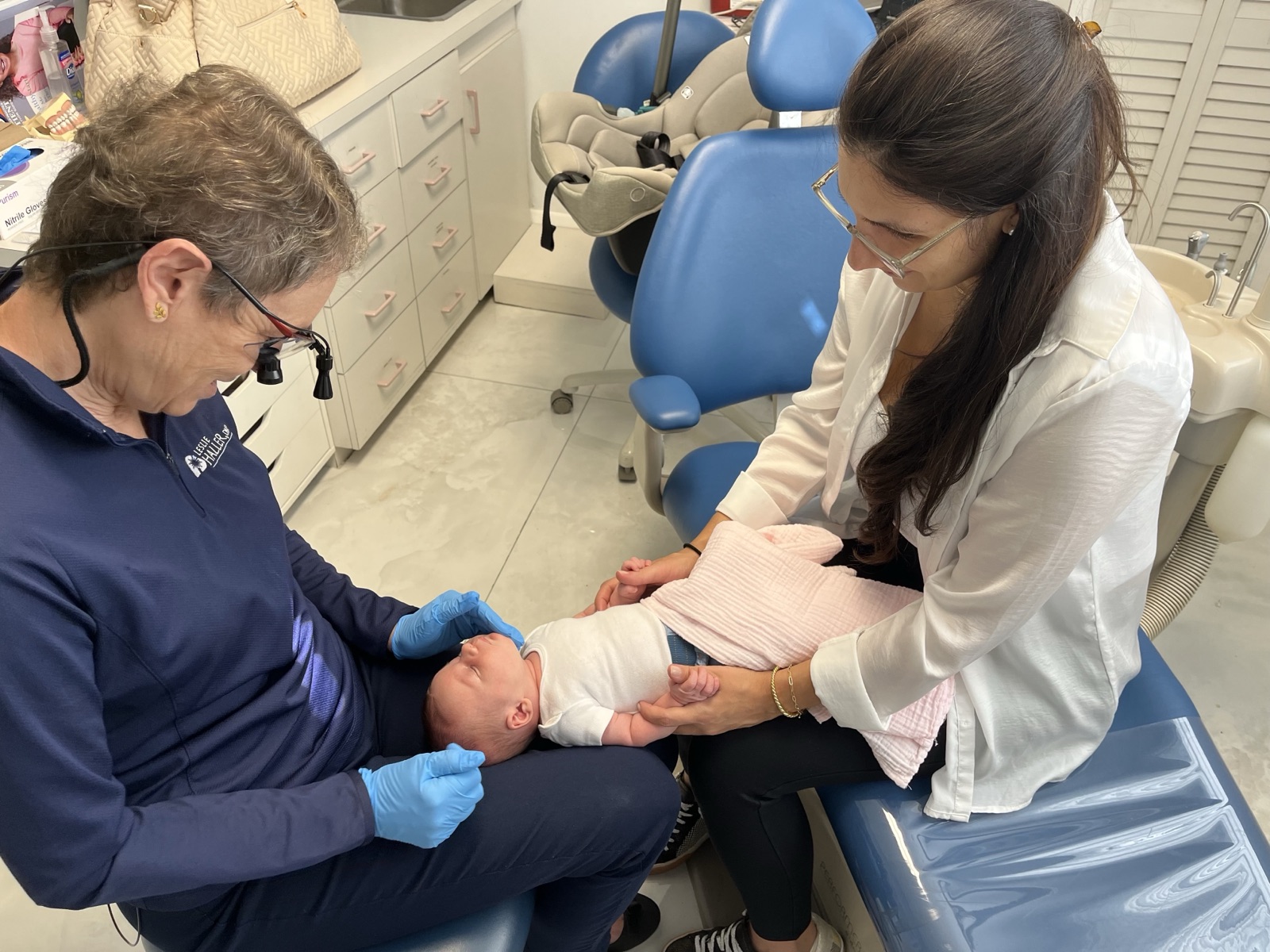
Dr. Haller evaluates for all of these at every infant consultation.
Mother symptoms
- Severe nipple pain during or after nursing
- Cracked, creased, or blistered nipples
- Plugged ducts or mastitis from poor milk drainage
- Feeling like baby never gets enough
- Considering stopping breastfeeding due to pain
Post-procedure care for infants
- Post-release stretching exercises are provided at the visit — every 4 hours for one week, then three times a day for three days
- Dr. Haller provides coconut oil with a hint of clove oil for pain relief
- Breast milk popsicles can also help soothe the site
- The diamond-shaped white scab is normal and healthy — not infection
- Myofunctional therapy is NOT required for infants — post-release stretches and suck training are sufficient
Breastfeeding — common questions
What if breastfeeding doesn’t hurt?
Some mothers with a strong let-down find that baby “gets away with” a shallow latch until around 3–4 months, when supply regulates and the inefficient latch becomes more apparent. The absence of pain does not rule out tongue tie.
Is releasing a tongue tie just so I can breastfeed?
No. An unresolved tongue tie has long-term consequences for airway development, jaw growth, speech, sleep, and posture. Breastfeeding is the immediate concern — but the release benefits the child for life.
Why do I have to do the post-op stretching exercises?
The frenulum can reattach if the wound edges are not gently separated during healing. Stretching exercises prevent reattachment and ensure the full range of motion is maintained. The protocol is every 4 hours for one week, followed by three times a day for three days.
What can I do for the pain after the procedure?
Infant Tylenol or Advil as directed by your pediatrician. Dr. Haller provides coconut oil with a hint of clove oil for topical relief. Breast milk popsicles are very soothing. The white diamond-shaped scab is normal — do not try to remove it.
What if my baby won’t eat after the procedure?
Some babies are fussy for 24–48 hours. Offering the breast or bottle frequently, skin-to-skin contact, and gentle oral massage often help. If you have concerns, call us directly — we are available for guidance after every procedure.
Is there any chance of infection?
No antibiotics are needed. The CO2 laser simultaneously sterilizes the tissue as it cuts. The diamond-shaped white scab that forms is healthy granulation tissue — not infection. It resolves on its own within 10 days.
— Jennifer K. · Infant Tongue Tie · Mother
Tongue tie in children & teens — beyond breastfeeding
Speech & feeding symptoms
- Delayed speech or speech impairment
- Difficulty pronouncing t, d, l, r, s, z, th
- Slow or picky eating — difficulty with certain textures
- Tongue thrust swallow pattern
Breathing, sleep & development
- Mouth breathing, snoring, restless sleep
- Crowded teeth, narrow arches
- Forward head posture
- Headaches, jaw pain
- ADHD-like symptoms — often airway-related sleep deprivation
- Dental cavities from chronic dry mouth
The ADHD connection
Many children diagnosed with ADHD are actually experiencing chronic sleep deprivation caused by airway obstruction — which is frequently downstream of tongue tie. A restricted tongue forces low tongue posture, mouth breathing, narrow palate development, and reduced airway space. Treating the tongue tie often transforms sleep, behavior, and school performance.
Myofunctional therapy for children
Myofunctional therapy before AND after release is strongly recommended for children old enough to cooperate — generally age 4 and older. It retrains the tongue, lip, and facial muscles to support nasal breathing and correct tongue posture. We refer to qualified providers in your area. Without MFT, old muscle patterns may persist even after the physical restriction is released.
The earlier we treat, the better the outcome
Children’s jaw and palate are still actively growing. Releasing a tongue tie early allows the tongue to apply natural upward pressure on the palate — promoting wider arch development, better nasal breathing, and reduced need for orthodontics. A child treated at age 4 has a very different developmental trajectory than one treated at age 14.
Adults
Tongue tie in adults — a lifetime of compensation
Pain & structural symptoms
- TMJ pain, jaw clicking or locking
- Chronic neck, shoulder, and upper back tension
- Migraine headaches
- Forward head posture
- Facial asymmetry or jaw misalignment
- Difficulty swallowing certain foods or pills
Sleep & airway symptoms
- Snoring or sleep apnea
- Teeth grinding (bruxism)
- Mouth breathing during sleep
- Daytime fatigue and brain fog
- Waking unrefreshed despite adequate hours
Myofunctional therapy — essential for adults
Adults have spent decades compensating. Releasing the frenulum removes the restriction — myofunctional therapy retrains the patterns that formed around it. Almost always essential for adults.
What to expect as an adult
Adult releases take the same 10–20 minutes as infant releases. Local anesthetic is used. The procedure itself is straightforward — the real work is the myofunctional therapy that comes before and after the release. Most adults experience instant improvement in neck and shoulder tension and tongue mobility. Sleep, posture, and pain improvements often continue to unfold over weeks to months as the muscles retrain.
“I had TMJ pain and chronic neck tension for fifteen years. Three months after my tongue tie release and myofunctional therapy, both are dramatically better. I wish someone had caught this decades ago.”
— Adult patient · Coral Gables
The missing piece
Myofunctional therapy — why release alone is not enough
What is myofunctional therapy?
Myofunctional therapy (MFT) is a program of orofacial exercises that retrains the muscles of the tongue, lips, face, and throat. It establishes nasal breathing as the default, correct tongue resting posture (on the roof of the mouth), and proper swallowing patterns — all of which support airway health, jaw development, and sleep quality.
What MFT helps with
- Establishing nasal breathing habit
- Correcting tongue resting posture
- Eliminating tongue thrust swallow
- Reducing mouth breathing and snoring
- Supporting arch expansion results
- Preventing tongue tie reattachment
- Improving speech clarity
- Reducing TMJ tension and neck pain
Treatment timeline
1. MFT before release (children 4+ and adults)
Prepares the muscles, establishes nasal breathing patterns, and sets the foundation for successful rehabilitation after release.
2. CO2 laser release
10–20 minute procedure. Minimal discomfort. No sutures. Safe from 2 days old. Immediate improvement in tongue mobility.
3. Post-op stretching (all ages)
Every 4 hours for one week, then three times a day for three days. Dr. Haller reviews exercises before you leave. Infants: coconut/clove oil, breast milk popsicles for comfort.
4. MFT after release (children 4+ and adults)
Retrains compensatory muscle patterns. Establishes correct tongue posture, nasal breathing, and swallow pattern. Typically 3–6 months of sessions with a qualified MFT provider.
We refer to qualified MFT providers
Dr. Haller does not perform myofunctional therapy in-office but maintains relationships with qualified myofunctional therapists. We will provide a referral and coordinate care throughout your treatment.
Your questions answered
My pediatrician said my baby doesn’t have a tongue tie — should I get a second opinion?
Yes — especially if you are experiencing significant breastfeeding difficulty. Posterior tongue ties in particular are frequently missed on visual exam because the tongue appears to move freely. A provider trained in palpation assessment can identify restrictions that are invisible to the untrained eye. Dr. Haller evaluates both anterior and posterior ties at every infant consultation.
What is a reverse swallow and why does it matter?
A reverse swallow is when the tongue pushes forward and out of the mouth with every swallow, rather than lifting upward to the palate. It is a compensatory pattern — the tongue cannot lift due to the restriction, so it thrusts forward instead. Many providers interpret this forward movement as evidence that the tongue is free. In reality, it is a red flag for tongue tie. Left untreated, a reverse swallow pattern reshapes the jaw and narrows the dental arch over time.
Does the procedure hurt?
For infants we use a tiny amount of Lidocaine injected locally, and the procedure takes only a few minutes. Most infants settle quickly afterward and nurse within minutes. For older children and adults, local anesthetic is used and the procedure is no more uncomfortable than a routine dental procedure. While the CO2 laser causes minimal trauma to surrounding tissue, it is still a burn — so post-operative discomfort is similar to a “pizza burn” under the tongue. For the first two days we recommend anti-inflammatories for pain control as well as eating cold foods.
Does insurance cover tongue tie release?
Our practice is fee-for-service. We provide a Letter of Medical Necessity and the appropriate insurance codes so you can submit for potential reimbursement. Some medical insurance plans do cover frenectomy — particularly for infants with documented breastfeeding difficulties or children with diagnosed speech impairment. We are happy to assist with the paperwork.
What is the SIDS connection Dr. Haller has researched?
Dr. Haller has published research in the Journal of Rare Disorders (2016) exploring the relationship between oral restrictions, airway obstruction, and sudden infant health events. A tongue tie that impairs nasal breathing and promotes mouth breathing may have implications for infant airway safety during sleep. This is an area of ongoing research and one of the reasons Dr. Haller is passionate about early identification and treatment of tongue ties in newborns.
Refer a patient — we make it seamless
Refer a patient
For infants with breastfeeding difficulty, children with speech delay or sleep-disordered breathing, or adults with TMJ, sleep apnea, or chronic tension. We evaluate, treat, and report back to your office.
- Prompt appointments for referred patients
- Post-procedure summary sent to your office
- MFT and lactation consultant coordination
- We preserve your patient relationship throughout
Provider resources
We welcome collaboration with lactation consultants, IBCLCs, speech-language pathologists, myofunctional therapists, and pediatric dentists. If you’re working with a patient you suspect has a tongue tie, we’re happy to consult.
- Direct consultation line: (305) 447-9199
- Email: dentistry@lesliehallerdmd.com
- Lunch-and-learn available for your practice
- Patient education materials available on request