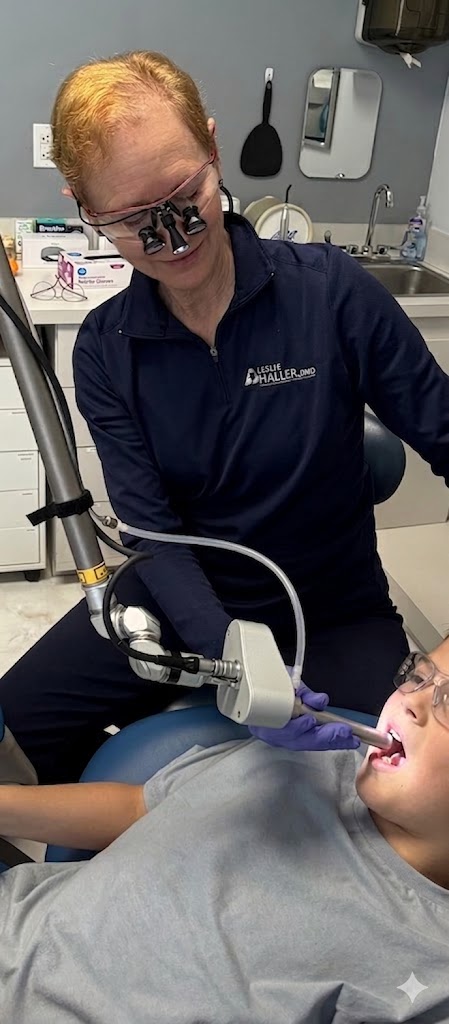
Laser Tonsil Treatment without surgery.
Important: We treat tonsils only — NOT adenoids. Adenoids sit behind the airway where the laser beam cannot reach them. If your concern is enlarged adenoids, laser treatment is not an option.
- \No general anesthesia — most patients feel mild warmth at most
- \Preserves immune tissue that a tonsillectomy removes
- \Surgery remains available if ever needed — nothing is lost by trying
- \10–15 minutes per session, same-day return to school or work
- \Eliminates tonsil stones in adults
10–15
minutes per session
3–6
sessions in a typical course
0
days of downtime
An alternative to tonsillectomy — not a replacement when surgery is needed
Laser treatment is a first-line option before surgery. If it doesn’t achieve adequate reduction, surgery remains available and we’ll help coordinate it with your ENT.
We treat the whole airway, not just the tonsils
Tonsils don’t enlarge in isolation. Dr. Haller evaluates tongue posture, jaw development, nasal airway, and sleep — so results last.
Why do tonsils become — and stay — enlarged?
When children or adults have enlarged tonsils affecting their sleep, the first line of defense is usually antibiotics. If antibiotics stop working, the next recommendation is surgical removal. That eliminates the obstruction, but it requires general anesthesia and a hospital stay — and it doesn’t address why the tonsils enlarged in the first place.
Mouth breathing exposes the tonsils to constant dirty, unfiltered air. That leads to infection which causes the tonsils to swell. Antibiotics often clear the infection — but repeated infection from chronic mouth breathing can lead to a bacterial biofilm that antibiotics cannot reach.
The problem
- Mouth breathing is usually the underlying cause. The nose is designed to filter, humidify, and clean air before it reaches the tonsils. Mouth air — full of bacteria and allergens — hits the tonsil tissue directly.
- Bacteria form a protective biofilm deep in tonsillar crypts, shielded from antibiotics and unreachable by the immune system.
- The chronic immune response keeps tonsil tissue swollen and permanently enlarged.
- Result: narrowed airway, disrupted sleep, snoring, ADHD-like symptoms, halitosis.
The solution: CO2 laser cryptolysis
A CO2 laser penetrates where antibiotics cannot.
- A specialized CO2 laser attachment delivers targeted energy into tonsillar crypts.
- The process — cryptolysis — eliminates chronic bacterial biofilm at its source.
- Thermal energy reduces vascular engorgement and stimulates lymphatic drainage.
- Tonsils measurably shrink as chronic inflammation resolves.
- Shrinking the crypts also dislodges tonsil stones — calcified bacterial colonies that often pop out on their own or become much easier to remove.
For adults: a quick and painless fix for tonsil stones
Tonsil stones (tonsilloliths) are calcified bacterial colonies that form deep in the tonsillar crypts — the source of persistent bad breath, throat discomfort, and the “something stuck” sensation many adults learn to live with. Because the laser shrinks the crypts themselves, the stones lose the place they form in. Existing stones often pop out on their own during the treatment course, or become loose enough to remove easily. The same shrinkage that helps a child’s airway is what eliminates an adult’s tonsil stones.
Who benefits from laser tonsil treatment?
Children who snore
Enlarged tonsils narrow the airway, causing turbulent airflow — the source of snoring. Tonsil reduction often resolves it without surgery.
Children labeled ADHD
Many children diagnosed with ADHD are actually experiencing chronic sleep deprivation from airway obstruction. For them, tonsil reduction can be transformative.
Recurrent tonsillitis
Repeated infections despite antibiotic courses is a sign of persistent biofilm that antibiotics can’t eliminate. Laser decontamination reaches where antibiotics can’t.
Chronic bad breath
Persistent halitosis despite good oral hygiene is a classic sign of bacterial biofilm in tonsillar crypts — the same crypts where tonsil stones form.
Grade 2–3 enlargement
Moderate to significantly enlarged tonsils respond best to laser treatment. Measurable shrinkage typically begins within days.
Grade 4 — worth trying first
“Kissing tonsils” may still benefit from a laser trial before committing to surgery. If it doesn’t work, surgery remains an option.
The chain — what we address together
If allergies have been ruled out
Ways we restore nasal breathing
Nasal sprays
Steroid or saline sprays open up stuffed noses and sinuses as a first-line medical option.
Nasal strips or Mutes
Mechanical aids that help keep the nose physically open at night.
SONU headband
Uses natural sound waves to resonate with and clear clogged, congested sinuses.
Nasal Release Therapy (NRT)
A gentle in-office technique that physically widens the nasal passages and improves airflow.
Dental arch expansion
Widens the palate and nasal passages permanently — making nasal breathing the path of least resistance.
Tongue tie release
If a tongue tie is the underlying problem, we coordinate with myofunctional therapists before and after release. Dr. Haller has performed hundreds of releases.
Results, in patients’ own words
“My son’s tonsils were Grade 3 and his pediatrician wanted a surgical referral. After 4 laser sessions with Dr. Haller, they’re barely visible. No surgery, no hospital, no recovery time.”
Maria T.
Tonsil Laser Treatment · Parent
“My daughter had been snoring since she was three. After two sessions her snoring was noticeably better. By session five it was gone entirely. I wish we’d found Dr. Haller years earlier.”
James R.
Parent · Tonsil Laser Treatment
“I’d had bad breath for years despite brushing obsessively. Three laser sessions later it’s gone. Turns out it was bacterial biofilm in my tonsils the whole time. Simple, painless, life-changing.”
Angela M.
Adult · Recurrent Tonsillitis
Laser decontamination vs. tonsillectomy
Laser cryptolysis
- In-office — no hospital stay
- No general anesthesia required
- 10–15 minutes per session
- Same-day return to school or work
- Preserves immune tissue
- Surgery remains available if needed
- 3–6 sessions spaced out over weeks
Tonsillectomy
- Hospital or surgery center
- General anesthesia required
- Weeks of recovery
- Throat pain, possible bleeding risk
- Permanently removes lymphoid tissue
- Not reversible
- One procedure
Can the laser shrink adenoids?
No. Laser decontamination works only on tonsils. Adenoids are located behind the airway, out of the laser beam’s reach, so we cannot treat them. Patients with enlarged adenoids should see an ENT to discuss their options.
Does laser treatment remove tonsil stones?
Tonsil stones are calcified deposits that form inside tonsillar crypts — the same folds where bacterial biofilm accumulates. They are not random. They are the direct result of bacterial colonies hardening over time inside the crypt pockets.
The same laser treatment that decontaminates the tonsils also eliminates the conditions that cause stone formation. As the tissue shrinks, stones are forced out. Most patients who complete a full laser course report complete resolution of tonsil stones.
Common symptoms of tonsil stones
- Persistent bad breath despite good oral hygiene
- Visible white or yellow spots on the tonsils
- Foreign body sensation or throat tightness
- Metallic taste in the mouth
- Chronic sore throat or difficulty swallowing
- Recurrent coughing or choking sensation
What if laser treatment isn’t enough?
Nothing is lost by trying. Surgery remains available — and we’ll help coordinate it if needed.
Laser decontamination does not burn bridges. If a full course of laser treatment does not achieve adequate tonsil reduction, surgical removal remains available. We provide a detailed clinical progress report — including before and after photographs and grade measurements — to any ENT you choose. In most cases, the laser course also confirms whether surgery is truly necessary.
The research is clear
500-case retrospective review
A retrospective review of 500 consecutive laser tonsil cryptolysis procedures found minimal complications, low conversion rate to surgery, and high patient satisfaction. The authors concluded it is a viable office-based alternative for cryptic tonsillitis and tonsilloliths.
Biofilm architecture research
Research by Stoodley et al. confirmed that tonsil stones exhibit the same architecture and behavior as dental biofilms — anaerobic bacterial colonies that antibiotics cannot penetrate. This is why laser, not antibiotics, is the appropriate treatment.
Stoodley et al. · ScienceDirect
Halitosis resolution
Halitometry studies following CO2 laser cryptolysis showed a measurable 30% reduction in volatile sulfur compounds — the molecules responsible for bad breath — with complete resolution of halitosis in many patients.
Dal Rio et al. · CO2 Laser Ablation Study