
A custom oral appliance — quiet, comfortable, effective.
For many adults with sleep apnea or snoring, a custom-fitted oral appliance — also called a mandibular advancement device, or MAD — is the simplest, quietest, most patient-friendly treatment available. Often covered by medical insurance. No mask, no hose, no machine.
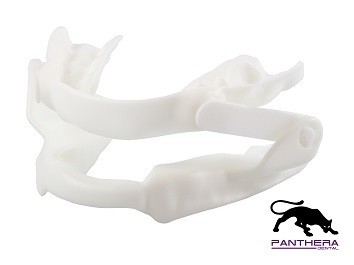
Panthera D-SAD™ shown
A custom appliance that holds the airway open.
Custom-fitted, not over-the-counter
Pharmacy “boil-and-bite” appliances are not the same. A medical-grade MAD is custom-made to your bite from precise impressions, with adjustable advancement and durable materials designed for years of nightly use.
Quiet and travel-friendly
No mask, no hose, no power. The appliance fits in a small case and can go anywhere. Most patients find them dramatically easier to live with than CPAP — especially for travel.
FDA-cleared for sleep apnea
Custom MAD devices are FDA-cleared for the treatment of mild and moderate obstructive sleep apnea, and for severe OSA in patients who cannot tolerate CPAP. Recognized in clinical guidelines as a first-line option.
Is an oral appliance right for you?
Oral appliance therapy works best for specific patient profiles. Dr. Haller will help you determine if a MAD is the right starting point, the right alternative, or whether a more comprehensive approach makes sense.
Common candidates
- Diagnosed mild or moderate obstructive sleep apnea
- Loud snoring without diagnosed apnea (after evaluation)
- CPAP users who travel often and want a quiet alternative
- Patients who’ve tried CPAP and abandoned it
- Patients who want immediate relief while exploring longer-term options
Often not the best fit
- Severe central sleep apnea (not obstructive)
- Significant TMJ dysfunction that worsens with jaw advancement
- Insufficient remaining teeth to anchor the appliance
- Active, untreated periodontal disease
- Patients who would benefit more from addressing the structural cause — see airway expansion
A sleep study comes first
For diagnosed sleep apnea, a sleep study is required before a MAD can be fabricated — both for clinical reasons and for insurance reimbursement. If you haven’t had a sleep study, Dr. Haller can refer you to a sleep physician. Home sleep tests are often appropriate.
An appliance manages the airway. Expansion changes it.
A MAD device holds the jaw forward each night to prevent airway collapse — it’s management, not anatomy change. Adult airway expansion takes a different approach: it gradually widens the dental arches and nasal passages, creating a permanently larger and more resilient airway.
A bigger picture
Curious how a MAD compares to permanent airway expansion?
See the full side-by-side comparison — what each does, how long treatment takes, what happens after, and which patients benefit most from each approach.
Common questions about oral appliances.
Is a MAD as effective as CPAP?
For mild and moderate sleep apnea, oral appliances are clinically effective and recognized as a first-line treatment in current guidelines. For severe OSA, CPAP remains more effective on average, but a MAD is often the right choice for patients who cannot tolerate CPAP — partial treatment is better than no treatment.
Will it hurt or feel uncomfortable?
Most patients have a brief adjustment period of one to two weeks — some jaw soreness, extra saliva, or minor tooth sensitivity is normal. These resolve quickly. Once adapted, most patients report sleeping more comfortably than they have in years.
How long does a MAD last?
A well-made custom MAD typically lasts three to five years with regular cleaning and proper storage. Replacement is usually covered by medical insurance on a similar schedule.
Will it move my teeth?
Long-term MAD use can cause minor changes in tooth position over years — usually a slight forward tipping of the lower teeth or a small bite shift. Regular follow-ups, careful fitting, and morning repositioner exercises minimize this. We monitor for changes at every check-up.